
How long will it take to recover from a concussion?
For most people, recovery from a concussion happens within a few weeks. However, delayed concussion symptoms and long-term effects like post concussion syndrome years later can occur, especially if the injury isn’t diagnosed early or if proper, holistic care isn’t provided.
A concussion is a mild traumatic brain injury (TBI) that can affect how your brain functions for days, weeks, or even months. While many people experience a relatively quick recovery, some face complex healing journeys. Understanding what’s normal and when to seek help is key.
Common Concussion Symptoms and Recovery Timeline
Most people with a mild concussion recover within 7–14 days, with an average of about 10 days in adults and up to 4 weeks in children and adolescents. According to a comprehensive Canadian study that followed 285 concussion patients using international sport concussion criteria, fewer than one-third of individuals with concussions fully recovered without intervention.
Typical symptoms include:
- Headaches
- Dizziness or balance problems
- Brain fog or difficulty concentrating
- Fatigue
- Nausea
- Sleep disturbances
However, recovery isn’t always linear.
Factors such as prior concussions, age, and lack of early treatment can extend the recovery timeline.
Can Concussion Symptoms Be Delayed?
Can concussion symptoms be delayed?
Yes—delayed concussion symptoms are well-documented. Some symptoms may emerge hours or even days after the injury, especially when the initial trauma is subtle or dismissed as minor.
Research published by the University of Queensland and supported by Houston Methodist shows that symptoms such as headaches, fatigue, irritability, sleep issues, and cognitive difficulties can appear or worsen 24–72 hours post-injury.
A 2023 review in Frontiers in Neurology also confirmed that early clinical follow-up significantly reduces the risk of persistent symptoms in children and adolescents.
As a functional medicine professional, exercise physiologist, and clinical care team member at the VA’s War Related Illness and Injury Study Center (WRIISC), I have a daily front-row seat to the human cost of Traumatic Brain Injuries (TBI). Concussion911 would be my recommended first-line intervention for anyone looking to optimize brain healing.

Why Does This Matter?
Without prompt evaluation and an individualized treatment plan, patients are more likely to develop post concussion syndrome years later—a complex condition where symptoms persist for months or even years after the initial injury.
How Long Do Headaches Last After a Concussion?
When asking “How long do headaches last after a concussion?”, the answer can vary greatly:
- Most concussion-related headaches resolve within 10–14 days in adults and children.
- Some may linger for weeks or months, especially if symptoms escalate or are unmanaged.
Factors that prolong headache duration include:
- Previous concussions, which often double recovery time—24 days vs. 12 days for first-time patients.
- Persistent post-concussion symptoms—about 15–30% of people experience symptoms for 3–6 months, with a smaller percentage continuing beyond a year.
- Types of headaches—post-traumatic headache is different from migraine or tension headaches and may not respond well to standard medications.
Understanding Post Concussion Syndrome (PCS)
If you’re wondering “post concussion syndrome years later”, this section helps clarify why.
Post Concussion Syndrome (PCS) is diagnosed when symptoms—such as headache, dizziness, memory problems, mood swings, or fatigue—persist beyond three months.
- Up to 20–30% of adults develop PCS, and around 15% report symptoms persisting for over a year.
- Children and adolescents with delayed care often face prolonged symptoms.
- Around 50% of PCS patients remain significantly impaired six months post-injury, and 20% still haven’t returned to work after a year.
These findings underscore how post concussion syndrome years later is a real risk—emphasizing the importance of early, comprehensive intervention.
What This Means for You
- If you’re still battling headaches 3+ months after a concussion, it may be time to explore PCS.
- Don’t ignore delayed symptoms—especially if your headaches, brain fog, or mood swings are persisting longer than expected.
- Every concussion is different—don’t assume your headache won’t improve unless you’re proactive.
Recovery Snapshot:
| Timeline | Expected Outcome |
| 7–14 days | Most symptoms resolve with proper intervention, like concussion911 |
| 2–4 weeks | Some symptoms may go, others, like headaches, may linger |
| 1–3 months | Watch for persistent symptoms—some individuals enter PCS territory |
| 12+ months | About 15–35% still report lingering symptoms like headache or brain fog |
What Increases the Risk of Long-Term Recovery?
Recovery from a concussion isn’t always smooth. Several factors can increase your risk of extended healing or even chronic symptoms down the road:
1. Delayed concussion symptoms and late diagnosis
In a study that followed 285 concussion patients using international sport concussion criteria, fewer than one-third of individuals with concussions fully recovered without intervention (3). Additionally, those who experienced symptoms for more than three years showed no signs of further recovery.
2. Higher age, previous concussions, or baseline mental health issues
Older adults, those with prior concussions, and individuals with pre-existing mental health conditions (like anxiety or depression) are at an increased risk for prolonged recovery.
One study noted that certain symptoms, like headaches or migraines, combined with a mental health history, significantly predicted slower recovery processes.
3. Severity of initial symptoms
The seriousness of your initial symptoms—such as dizziness, blurred vision, cognitive fog, or headache—can influence how long it takes to bounce back. If many symptoms occurred early after the injury, or if they were intense, recovery may take longer.
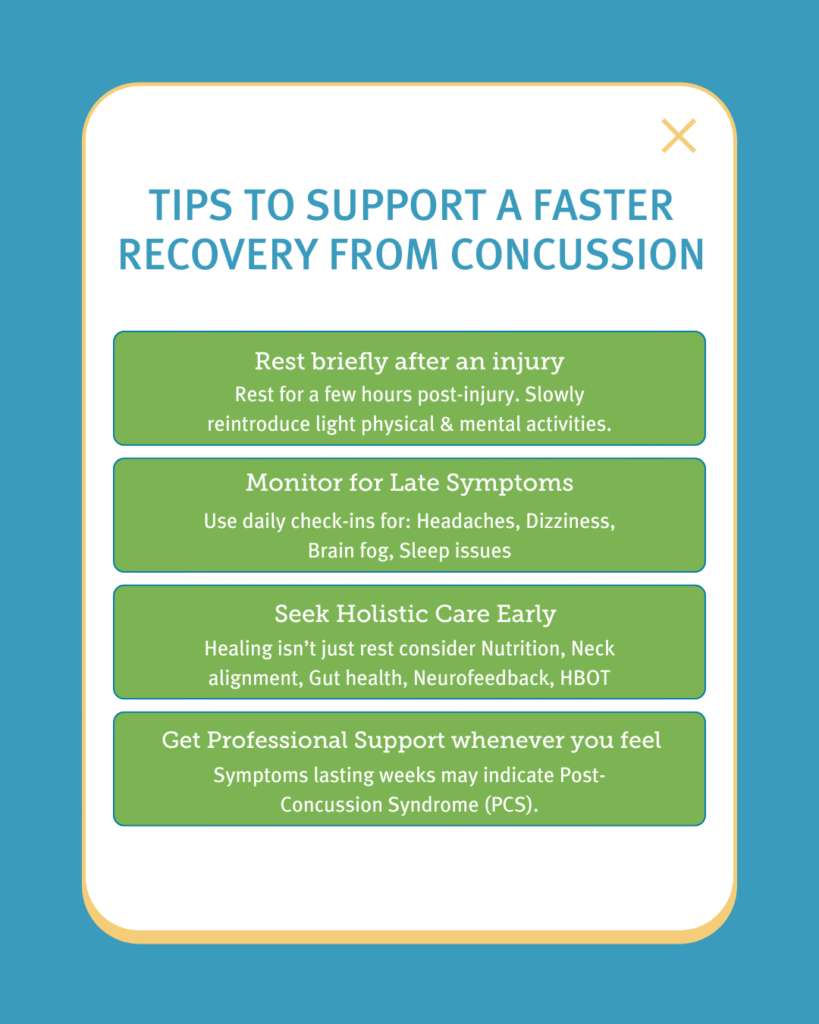
Tips to Support a Faster Recovery
Taking action early and sensitively can significantly boost your healing process—here’s how to support your brain’s recovery:
Rest—but don’t go “all or nothing”
Official guidelines recommend 24–48 hours of relative rest, followed by gentle re-introduction of physical and mental activities.
The cornerstone of recovery recommendations has centered on “brain rest” for many decades.
According to the National Federation of State High School Associations (NFHS) and the Sports Medicine Advisory Committee (SMAC), the number one priority for concussion recovery is simple: rest (17). Their suggested guide for concussion management in sports claims that “The first step in recovering from a concussion is rest” (17) Sources like Johns Hopkins School of Medicine and the University of Michigan Health & Medicine publicly recommend and concur that full rest is paramount for concussion treatment and recovery. “In the first one to two days after suffering a concussion, near complete rest is important.” (18)
While traditional recovery recommendations have focused on ‘brain rest’ and reduction of neurostimulating activity until symptoms subsided, emerging literature now supports a return to exercise early in the course of mild TBI recovery as beneficial to the recovery timeline (25, 26, 27, 28).
Recent guidelines also emphasize the importance of cognitive and physical rehabilitation. The CDC submitted a report to Congress entitled Traumatic Brain Injury in the United States: Epidemiology and Rehabilitation, writing that TBI rehabilitation involves cognitive and physical therapies (19). Cognitive rehabilitation addresses cognitive deficits (learning, comprehension) and behavior, while physical rehabilitation focuses on improving mobility and ocular movement coordination.
These advancements in post concussion care, while leading to improved outcomes, continue to leave a gap in metabolic and anti-inflammatory support. Scientific advancements show that metabolic interventions during the early post-injury period can complement these approaches.
More research is clearly indicated, as the vulnerable window immediately following a concussion remains a potential opportunity where metabolic intervention could speed the brain in return to full function. The keys to a return to balance are the restoration of accessible energy sources, reduction of inflammation, and support for detoxification pathways—all essential for cellular repair and neurological stability.
Monitor closely for late symptoms
Just because you feel alright doesn’t mean you’re back to normal. Use daily check-ins: note headaches, dizziness, light sensitivity, fatigue, brain fog, or sleep changes. Tracking helps catch delayed concussion symptoms early, especially as they may signal developing post-concussion complications.
Seek holistic care early
Early help isn’t just about rest—it spans nutrition, neck alignment, gut health, and regenerating therapies like neurofeedback and hyperbaric oxygen therapy (HBOT). Research shows that multidisciplinary approaches lead to more consistent outcomes and shorter recovery times.
If symptoms persist, seek professional support
Still struggling after a few weeks, or seeing new or worsening symptoms? It could be post concussion syndrome (PCS) . Early intervention from trained professionals, especially those using holistic practices like Concussion911, can prevent long-term effects.
Why This Matters for You
- Early evaluation is crucial—studies show that getting help within 48 hours speeds healing by up to a week. Delay past a week, and recovery could stretch much longer.
- If symptoms extend beyond 3 months, it may be post-concussion syndrome; comprehensive care then becomes essential.
- A flexible recovery plan—starting with relative rest, then progressing to gentle movement and guided therapies—is key to quick, full recovery.
Final Thoughts
How long will it take to recover from a concussion?
For most, recovery takes 1–2 weeks. But delayed concussion symptoms, ongoing headaches, or PCS can stretch the timeline. Watch for delayed effects, understand how long headaches can last, and remember that early, holistic care boosts recovery chances.
If your symptoms linger—or feel more intense than expected—don’t wait.
Reach out to My Concussion Dr for a personalized plan to guide your brain, body, and energy back to balance, clarity, and lasting recovery.
Help spread awareness: Share this guide with anyone recovering from a head injury — your brain deserves the best care.
Resources:
CDC: HEADS UP Concussion Resources
https://www.cdc.gov/heads-up/guidelines/recovery-from-concussion.html?CDC_AAref_Val
- Brain Injury Association of America (BIAA)
https://www.biausa.org/brain-injury/about-brain-injury/concussion - PubMed: Early versus Delayed Post-Concussion Care
https://pubmed.ncbi.nlm.nih.gov/30664866/ - Medscape: Post-Concussion Syndrome
https://emedicine.medscape.com/article/92189-overview - Northfield Hospital – Concussion Recovery After Injury or Fall
https://www.northfieldhospital.org/concussion-recovery-after-injury-or-fall - NCBI – Persistent Problems 1 Year After Mild Traumatic Brain Injury
https://www.ncbi.nlm.nih.gov/pmc/articles/PMC4684031/ - NCBI Bookshelf – Postconcussive Syndrome (Stats & Management)
https://www.ncbi.nlm.nih.gov/books/NBK534786/ - PMC – Prolonged Postconcussive Symptoms
https://www.ncbi.nlm.nih.gov/pmc/articles/PMC6586466/ - Medscape – Concussion Overview & Recovery Risks
https://emedicine.medscape.com/article/92095-overview - University of Michigan Health – Concussion Treatment & Recovery
https://www.uofmhealth.org/conditions-treatments/brain-neurological-conditions/concussion-treatment-and-recovery - Ada Health – Post‑Concussion Syndrome Facts
https://ada.com/conditions/post-concussion-syndrome/ - Verywell Health – Concussion Recovery Guide
https://www.verywellhealth.com/concussion-recovery-8701979
.
| Disclaimer: Concussion911 is a dietary supplement and is not intended to diagnose, treat, cure, or prevent any disease. This product has not been evaluated or approved by the U.S. Food and Drug Administration (FDA). Any statements made are for informational purposes only and are not medical advice. Always consult with a healthcare professional before beginning any new supplement. |